By: Lisa Richards
What happens when you take a tabletop roleplaying game built around conversation, dice, and character sheets and place it inside a persistent online world?
That is the challenge behind adapting Vampire: The Masquerade into an MMORPG-style experience using FiveM, a multiplayer modification framework for GTA V.
The goal is not simply to add vampires to the streets of Los Santos. It is to recreate the social politics, character progression, supernatural abilities, and consequences that make Vampire: The Masquerade compelling; while designing systems that can support a large, active roleplaying community.
Why Use GTA V?
GTA V already provides many of the foundations needed for a living roleplay world.
Players can already explore a large city, own businesses, drive vehicles, communicate through phones, gather in clubs, and interact with other characters in real time using FiveM. It also expands those possibilities by allowing developers to create custom interfaces, databases, jobs, commands, and gameplay systems.
However, GTA V nor FiveM was not designed around vampires, clans, blood bonds, or supernatural politics. Those elements must be built on top of the existing game.
That means translating a tabletop system into something the server can understand.
Translating a Character Sheet into a Game System
In tabletop play, a character sheet can be edited by writing on paper or changing values in an online form. In a persistent multiplayer server, those changes need more control.
In this server, each character must have a digital sheet containing information such as:
- Clan
- Generation
- Sect (Vampire Government they belong to)
- Attributes and abilities
- Disciplines
- Humanity or Path
- Merits and flaws
- Available and banked experience points
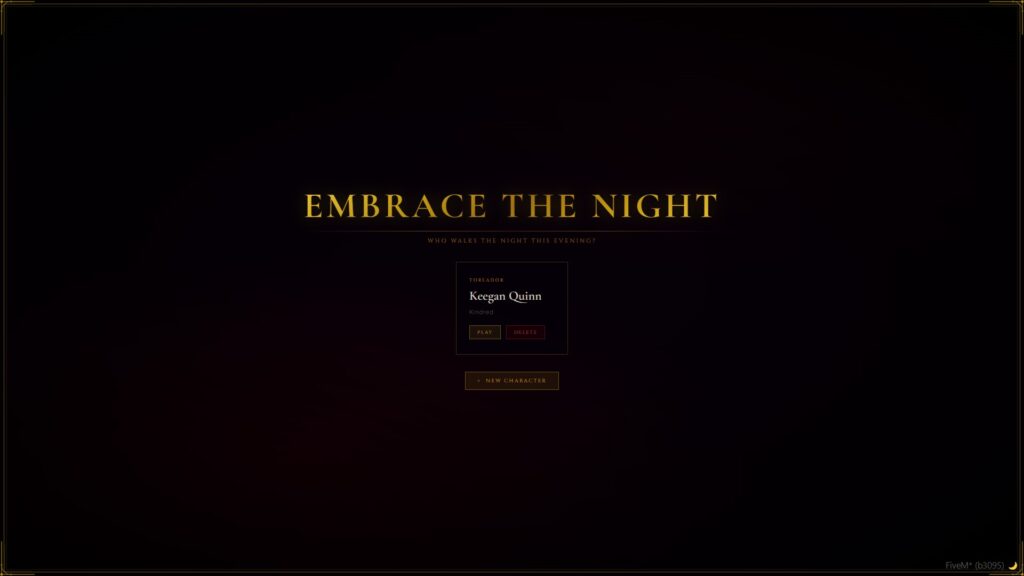
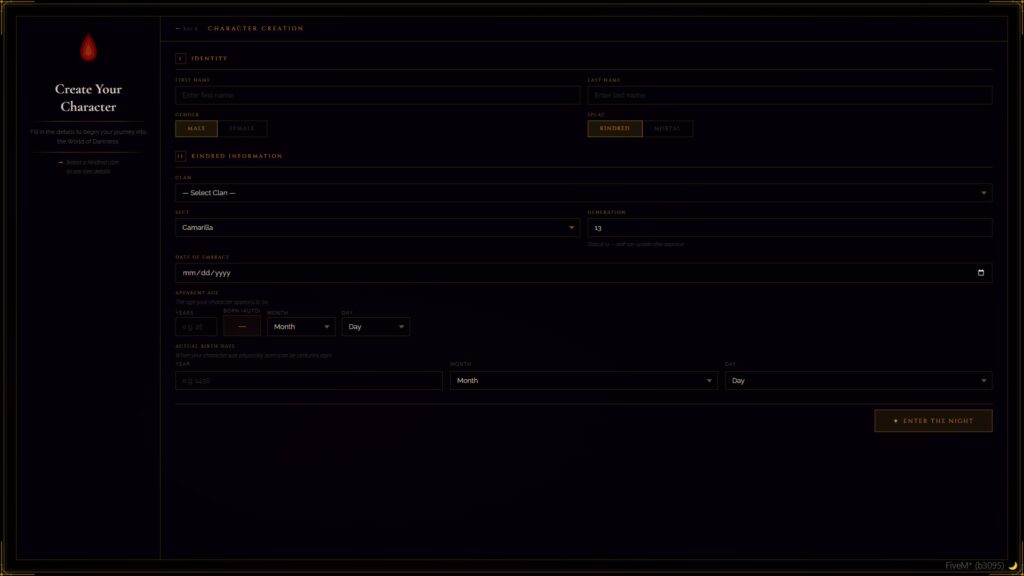
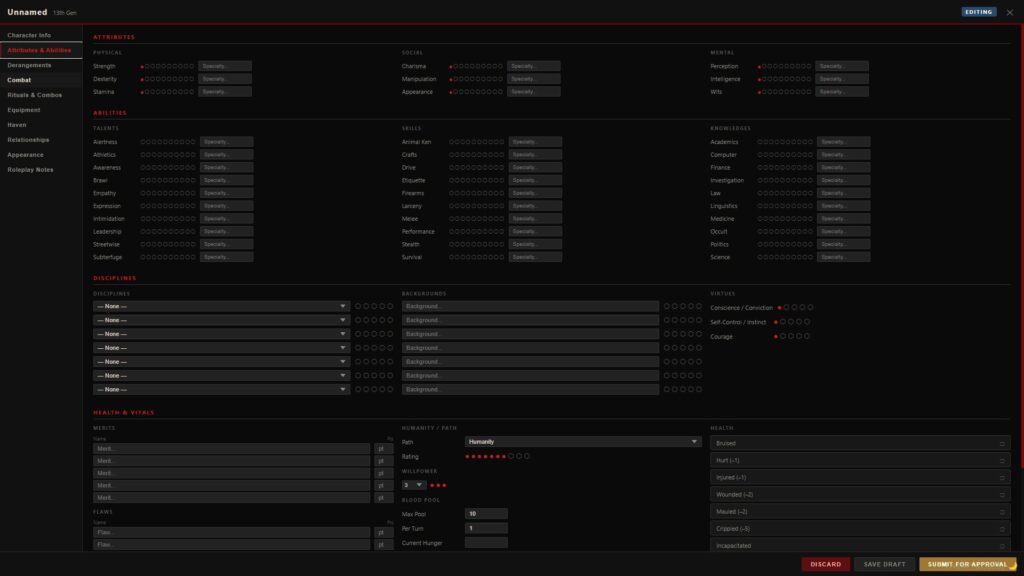
Once approved, the sheet becomes part of the character’s permanent server data.
Players cannot freely change approved statistics whenever they choose. Instead, the sheet locks until the player earns experience or receives permission from a Storyteller/Dungeon Master to make a story-related change. This protects character progression and prevents accidental or unauthorized edits.
When a player spends experience, the system creates a pending revision. Staff can then review exactly what changed, confirm the cost, and approve or reject the request.
This turns the traditional character sheet into a controlled progression system without removing the human oversight that tabletop roleplay depends on.
Building Disciplines as Shared Systems
Disciplines are one of the most important parts of any Vampire: The Masquerade adaptation. They are basically really cool vampire powers and each clan has special powers they can do.
Rather than attaching separate versions of a Discipline to every clan, each Discipline is defined once within the server. Its powers, descriptions, dot levels, and restrictions are stored in a shared configuration.
Clans then reference those Disciplines.
For example, a Toreador(one of the clans) may begin with access to Auspex, Celerity, and Presence. A Brujah (another clan) may begin with Celerity, Potence, and Presence. Both clans use the same version of Celerity because the Discipline itself is stored globally.
So this approach makes the system easier to update. If a Discipline needs to be revised, it can be changed in one location instead of being edited separately for every clan that uses it.
Clan membership determines how easily a character can learn something. In the tabletop, if you learn something that isn’t in your clan’s disciplines it costs more to level it up but it does not change what the power does.
With how the sheet is set up, the power remains the same, but the experience cost and roleplay requirements may be different.
Supporting Different Character Types
Not every character follows the same progression rules.
A standard Vampire begins with three clan Disciplines. A Caitiff chooses a personal set because they have no recognized clan. A Ghoul or a thrall of a vampire receives limited access based on the Disciplines possessed by their regnant.
These differences cannot exist only in written rules. The server needs to enforce them.
For example, a Ghoul should not be able to learn a Discipline their regnant does not possess. They also should not be able to raise that Discipline beyond their regnant’s generation limitations
By connecting the two character sheets, the server can automatically determine which options are available while still requiring roleplay and staff approval before the purchase becomes permanent.
Building the Foundation
These systems create the foundation for a persistent Vampire: The Masquerade roleplay world. Character sheets store each player’s identity and progression, Disciplines define their supernatural abilities, and clan-specific rules preserve the differences between Vampires, Caitiff, and Ghouls.
The challenge is not simply recreating the tabletop rules inside GTA V. It is deciding which rules should be automated, which should require staff oversight, and which should remain entirely in the hands of the players.
By building the structure around the roleplay rather than replacing it, GTA V and FiveM can become more than the setting for a vampire server. They can support a living World of Darkness shaped by the characters inside it.